
Copenhagen Metro
Four driverless lines, 44 stations and trains that never stop running — here is how to use the Copenhagen Metro, what a ticket costs and how long your journey will take.
4
metro lines
44
stations
24/7
trains every day of the year
2 min
between trains at rush hour
The Copenhagen Metro in one minute
Copenhagen’s Metro is small, fast and relentless. Four lines — M1, M2, M3 Cityringen and M4 — cover 43.3 km and 44 stations across the city, Frederiksberg and Amager, and they run around the clock, every day of the year. There is no timetable to memorise: at rush hour a train arrives about every two minutes, and even at four in the morning you will not wait more than twenty.
The trains are fully automatic — no driver, no cab — so the best seat in the city is the one at the very front, looking down the tunnel. Metro Service runs the system for Metroselskabet, and roughly 135 million journeys are made on it every year.
One ticket covers the Metro, buses, S-trains, regional trains and the harbour buses, and it is priced by zones, not by distance. The lowest fare is DKK 24, and because of the ring-zone rule an all-Metro journey never costs more than three zones — including the ride out to Copenhagen Airport.
The four metro lines
M1 and M2 share the same tracks from Vanløse right through the centre to Christianshavn, then split for Ørestad and the airport. M3 is a closed circle. M4 shares M3’s tunnel across town and branches off to the harbour at both ends.

M124/7
Vanløse ⇄ Vestamager

M224/7
Vanløse ⇄ Lufthavnen

M324/7
Circle line via Nørrebro, Østerbro and Frederiksberg

M424/7
Orientkaj ⇄ København Syd
Metro map of Copenhagen
All four lines and every station on one map, with the S-train and airport interchanges marked. Download the PDF to your phone before you land — it works with no signal.
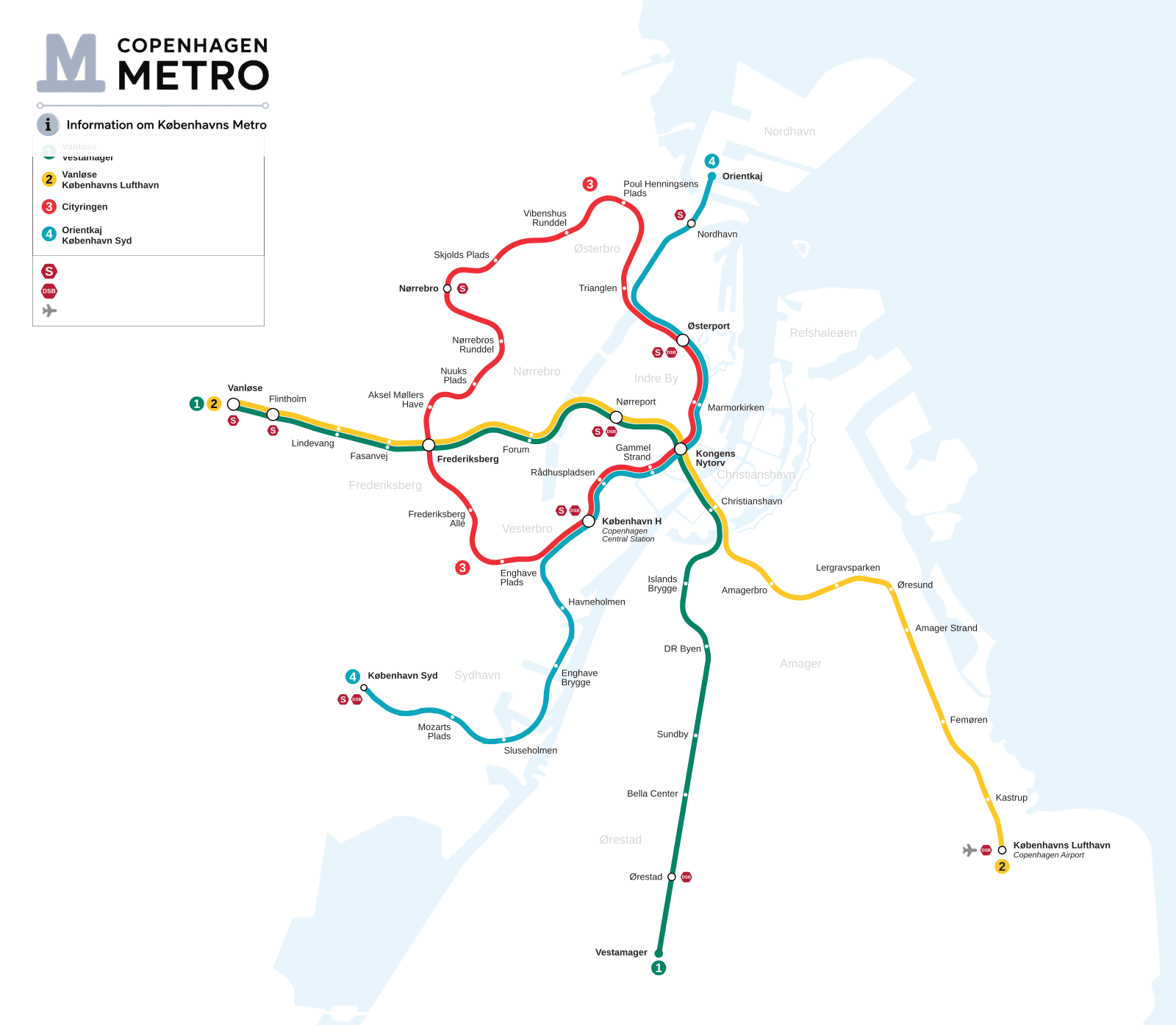
Network map by tomtom, CC BY-SA 4.0, via Wikimedia Commons — redrawn to the network as it runs today.
Is the Metro running right now?
Live departures from any station, straight from Rejseplanen — the national journey planner the operators themselves publish to.
Loading departures…
Departures from Rejseplanen, refreshed every 90 seconds.
What a metro ticket costs
Tickets are priced by zones and are valid on every kind of public transport in the area they cover.
| Journey | Valid for | Adult | Child 0–15 (about half) |
|---|---|---|---|
| 2 zones inside the city centre | 1 h 15 min | DKK 24 | DKK 12 |
| 3 zones city centre ⇄ airport, and any all-Metro journey | 1 h 30 min | DKK 30 | DKK 15 |
| 4 zones out into the suburbs | 1 h 45 min | DKK 38 | DKK 19 |
| 5 zones | 2 h | DKK 44 | DKK 22 |
| 6 zones | 2 h 15 min | DKK 48 | DKK 24 |
| 7 zones | 2 h 30 min | DKK 54 | DKK 27 |
| 8 zones | 2 h 45 min | DKK 60 | DKK 30 |
With the Rejsekort app or a Basiskort you do not choose zones at all: you check in, you check out, and the fare is calculated for you. Because of that, DOT does not publish a per-zone price list for pay-as-you-go — so we do not print one. What is published, and what actually decides what you pay, is this:
- 20% off outside rush hour — all day Saturday, Sunday and public holidays, and on weekdays from 11:00 to 13:00 and from 18:00 to 07:00. It is applied automatically.
- Two children under 12 travel free with a checked-in adult.
- One check-in covers the whole journey in the Rejsekort app, however many times you change. With a Basiskort you check out and in again when you change mode.
- Pensioners and people with disabilities pay a reduced rate automatically — see the discount table below.
- A bicycle or a dog can be checked in on the same card or app.
To see the exact price of a specific journey before you travel, use the fare calculator in the Rejsekort app — it is the only source that gives a figure for your zones and your discount profile.
Two children under 12 travel free with an adult who holds a valid ticket; a child travelling alone pays about half and may bring one other child under 12 free. A bicycle needs its own DKK 15 ticket on the Metro and cannot be taken during rush hour. Prices checked against DOT's published fares on 26 August 2026.
Rejsekort is gone — what to use instead
The blue plastic Rejsekort closed on 29 June 2026. If you have one in a drawer, the money on it can still be refunded. What replaced it is a choice of three: the Rejsekort app for tap-in/tap-out travel, the Rejsebillet app for single tickets and season tickets, and Basiskort — a physical card for people who would rather not use a phone.
Journeys people look up most
Lufthavnen → Kongens Nytorv
14 min · 8 stops · direct
M2
Lufthavnen → København H
18 min · 11 stops · 1 change
M2 M3
København H → Nørrebro
9 min · 7 stops · direct
M3
Nørreport → Vestamager
15 min · 8 stops · direct
M1
Kongens Nytorv → Orientkaj
7 min · 4 stops · direct
M4
København H → Christianshavn
6 min · 4 stops · 1 change
M3 M1
From the airport, and what to see along the line
The M2 runs straight into the city from Copenhagen Airport in 14 minutes, and most of what visitors come for is a short walk from a metro station.
Copenhagen Metro — questions people ask
Yes, but with two limits that catch people out. A bike needs its own DKK 15 Metro ticket, valid for 1 hour 30 minutes — and bikes are not allowed on the Metro during rush hour at all, not merely restricted to certain carriages. A folded bike or scooter travels free only if it fits within 30 × 60 × 100 cm; otherwise it counts as a full-size bike. Cargo bikes, long johns, tandems and fat bikes cannot be brought at any time.